The Myth of the Perfectly Level Playing Field
A perfectly level playing field is rarely needed for informal outdoor games. Set fair boundaries, agree simple ground rules and choose a surface that suits the group.
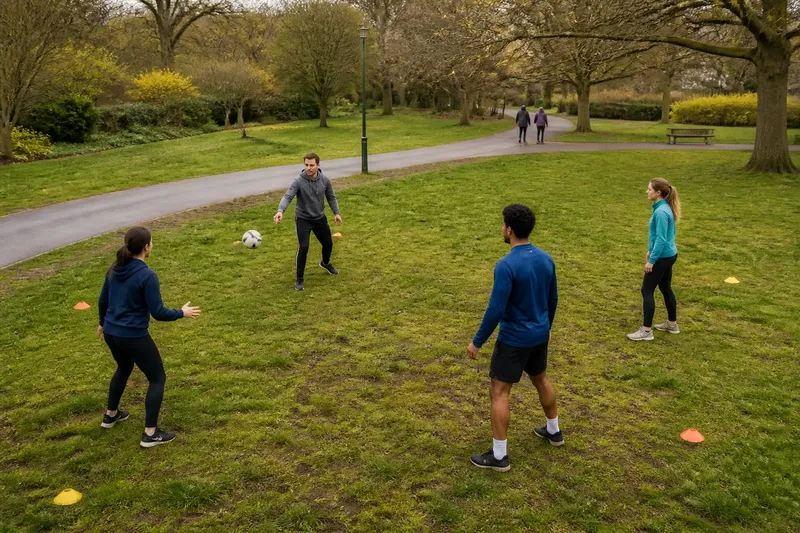
Can you play on grass that is uneven? For many informal outdoor games, yes: a perfectly level playing field is rarely necessary if the rules, boundaries and movement suit the ground. The decision is less about whether a lawn looks immaculate and more about whether everyone can play the same game on the same terms.
A mown lawn, a sloping common and a patchy park field each offer different possibilities. Before play, agree what counts as in bounds, how to restart after the ball goes out and which features are off limits. That short conversation prevents an awkward bounce or unclear edge from becoming a running dispute.
A fair playing field starts with rules everyone can repeat
Casual play does not need a regulation pitch, but it does need shared expectations. Choose landmarks players can recognise, state what happens when the ball crosses an edge and settle any special rule before the first turn.
Keep the arrangement simple enough to explain aloud. If players describe a boundary differently, revise it before starting rather than resolving every close call as it happens.
Choose the game before choosing the patch
Think about what the game asks players to do. A turn-taking throwing game, a passing game and a sprinting game place different demands on space and movement, so the same grass may suit one and frustrate another.
Match the ground to the actual play, not just its appearance from the edge. Walk the likely routes, note abrupt transitions between grass and paving, and check whether retrieving the ball would take players across a shared path. If an ordinary move repeatedly leads into a difficult area, changing the game or location is more sensible than adding a tangle of special rules.
Use boundaries to make the playing area easy to read
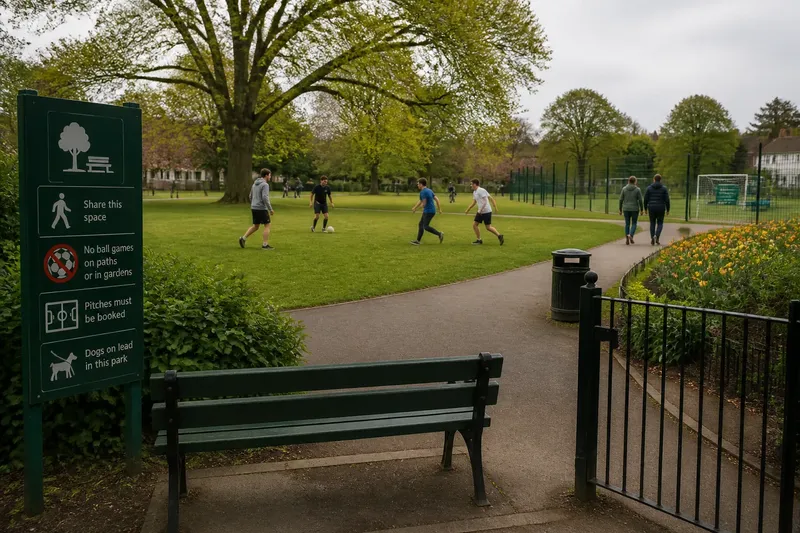
A useful boundary can follow an existing path, tree line or gap between benches. It need not form a rectangle; it should leave enough room for the game and keep players clear of other park users.
Use a few light markers at turning points if natural landmarks are not enough. Avoid placing anything where it could trip a player or draw play towards a walkway. Walk the boundary together and describe it from both sides before deciding it is clear.
- Check whether walkers and cyclists have a clear route; if not, shift the playing area or choose another patch.
- Check for holes, exposed roots or other features that players would have to cross; if present, exclude that section or move elsewhere.
- Check whether the usable space allows the game’s normal movement; if it feels cramped, choose a different game or a larger area.
- Check that each corner and end point is visible from where players will stand; if not, add a clear landmark or redraw the boundary.
- Check that everyone agrees what happens when the ball crosses the edge; if answers differ, settle one restart rule before play.
- Check that markers are easy to see and not in the way; if they could obstruct movement, remove them and use natural landmarks.
Imagine four friends reach a park with a grassy area crossed by a path. They want to play a passing game, so they first trace a boundary that leaves the path outside, then check whether the remaining space lets them pass without crowding one another. If it does, they keep that area and agree that a ball over the boundary returns to the player who last touched it; if it does not, they choose a wider patch instead. The result is a clear playing space and a rule everyone can apply.
Pick rules that suit the game rather than rewarding one side
For a game with flexible rules, players can agree to ignore an awkward bounce or treat a particular section as out of play. Apply the adjustment to everyone and make it easy to remember. A rule that changes according to which team has the ball will feel arbitrary.
For games built around fast movement, contested play or a predictable roll, prioritise a space that supports those demands. If the group cannot keep ordinary play away from a difficult feature, use a different patch or choose a slower game.
How do you decide whether the ground is suitable?
Does uneven ground always make a game unfair?
No. It is unfair when players face different conditions without a shared rule, or when one side repeatedly benefits from an unpredictable feature. Agreeing how to treat that feature can make a casual game fairer.
Does the playing area need to be a regular shape?
No. A boundary that follows a path or avoids a tree can be clearer than a neat rectangle that includes space the group cannot use. Choose a shape everyone can identify and that leaves room for the game.
When is it better to choose another game?
Change the game if its usual movements do not fit the available space, even after the group has set clear boundaries. A slower, turn-taking activity may suit a small area better than one that depends on running or chasing a rolling ball.
How should players settle a disputed boundary?
Pause and point to the landmarks that define the edge. If players still see different lines, move a marker or redraw the boundary together before continuing.
Check the shared space before the first turn
Start by naming the game’s main needs: room to pass, space to run, a reliable roll or a place to take turns. Then check that the boundary is clear, the rules apply equally and the activity leaves other people’s routes open.
The useful test for a perfectly level playing field is not how smooth the grass looks. It is whether the group can play the chosen game, understand the limits and apply the same rules. For a perfectly level playing field search, that distinction matters: a suitable space is defined by the activity and shared expectations, not by appearance alone.
Before the first pass, ask one player to trace the boundary aloud while another checks it from the opposite side. If both describe the same line, start; if not, clarify the edge first.