From Village Green to Public Park: Where Open Games Found Room
Learn how village greens and commons differ from public parks, and how to check access, layout and local rules before choosing a place for open games.
Where can an open game take place when a village green or common is no longer available? The change from shared ground to public park reshaped how people used open space, but its history varied by place and did not follow one universal path.
Village greens and commons supported overlapping uses
A village green was often an open space used for everyday activity as well as gatherings and informal games. Its value came partly from accommodating different needs, rather than being set aside for sport alone.
Commons had their own local arrangements. In many places, customary rights allowed local people to use common land for particular purposes, such as grazing or collecting resources; the rights and rules differed between communities. Recreation could share the ground with these practical uses.
Neither kind of space necessarily needed marked pitches or permanent equipment. Players could agree on a patch of clear ground and adjust their game around other people. Access, however, depended on the place’s ownership, customs and local rules.
Enclosure affected access differently from place to place
Enclosure changed the boundaries, ownership or management of many areas of common land, but its timing and effects varied across Britain. In some places, changes restricted customary uses or altered how the land was used; it would be misleading to treat every village as following the same pattern.
As towns expanded, open ground could become harder to find within built-up areas. Public parks developed in different circumstances as one way to provide managed spaces for recreation and gathering. They did not simply replace every green or common, and the reasons for creating them were not identical from town to town.
The useful distinction is between local arrangements tied to a particular green or common and a park managed for public recreation. Neither arrangement, on its own, tells you exactly who can use a place today.
Public parks planned for several kinds of recreation
A public park may combine paths, lawns, planted areas and facilities for sport or play. Its layout can support informal games on open ground alongside more organised activities on designated pitches.
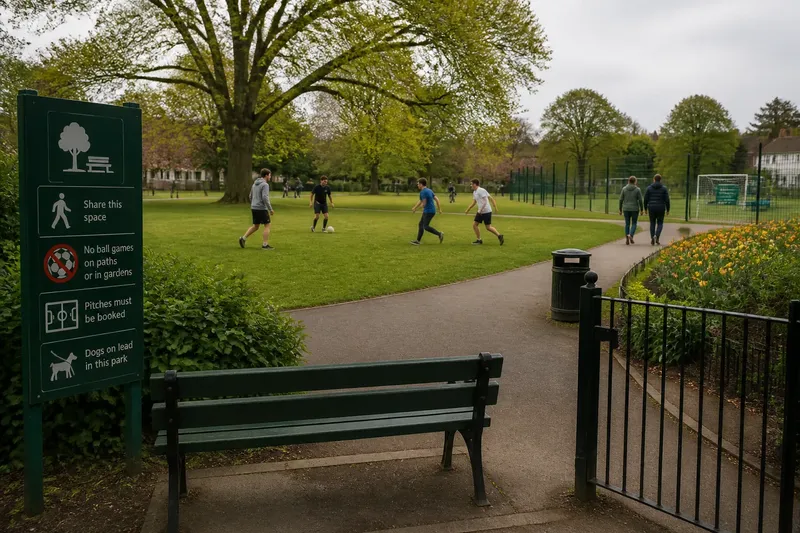
That planning also shapes where games fit. Signs, bookings, planted borders and paths can define boundaries, while park authorities may set rules for events or particular activities. Public access does not mean every use is allowed everywhere.
Before starting a game, check the park’s signs and any published guidance from its managing authority. A designated pitch may be the better choice for an organised match, while a quiet, clear lawn may suit a casual game if local rules permit it.
Park design influences where informal games can happen
A broad, unobstructed lawn can accommodate games that need little equipment. A path crossing the lawn may split the usable area, while benches, flower beds and playground equipment call for space to be left clear around them.
Trees can offer shade, but their position affects how much open ground is available. Players should also consider sightlines and avoid sending balls towards paths, seating or areas where people are gathering.
Imagine a group arriving at a park with a central lawn, a perimeter path and a separate pitch listed for organised bookings. They check the signs, choose a clear area away from the path and pause when walkers need to pass. The expected result is a casual game that leaves the route open and does not use the booked pitch.
Check access and local rules before choosing a place
An open gate does not tell you whether a particular game is permitted or whether the space is practical to use. Look at entrances, paths, signs, nearby facilities and any restrictions on bookings or equipment.
- Check the entrance signs for rules on ball games; if they allow the activity, choose a suitable clear area, but if they prohibit it, use another permitted space.
- Check whether the area is booked or reserved; if it is free for casual use, stay within the available space, but if it is reserved, find an unbooked area or return at another time.
- Check whether a path cuts through the playing area; if it does, keep the game well clear and pause for passers-by, but if there is no safe separation, move to a different patch.
- Check for planted beds, young trees or wildlife signs; if they border the space, keep play away from them, but if the area is protected or closed, do not use it.
- Check the ground for obstacles or uneven patches; if the surface is clear enough for the intended game, use a modest playing area, but if hazards remain, choose another location.
- Check whether the game would block benches, entrances or playground access; if it can fit without obstructing them, keep to that area, but if it cannot, move or choose a different game.
For an organised event, ask the park authority about permission and booking requirements rather than assuming that casual access covers group use.
How do greens and parks differ for open games?
Can a village green still host sport?
It may, if the local rules and rights allow the activity. Check the green’s signs or ask its managing body, since customary use and current arrangements vary.
Why were public parks created?
Different towns established parks for different local reasons, including recreation and public gathering. Their development should not be reduced to a single story of commons disappearing and parks taking their place.
Are public parks open to every kind of game?
No. Park rules, bookings, protected areas and the needs of other visitors can limit particular activities. Check local guidance before organising a match or bringing equipment that may be restricted.
What makes a park workable for casual play?
Usable open ground, clear access and room to avoid paths and other activities all help. A formal pitch is not always needed, but the game must fit the space and its rules.
Shared space depends on rights and practical access
Greens, commons and parks are not interchangeable. Greens and commons are shaped by their histories, local rights and uses; public parks are managed under their own rules and designs. Each can support open games where access and conditions allow.
When choosing a place for open games, check who manages it, what the signs permit and how your activity will affect other visitors. Those details matter more than the label on the space, and they help you find somewhere to play without blocking paths or taking over ground meant for others.