Chalk Lines or Cones for Marking a Casual Game
Chalk lines or cones can make a casual game easier to read. Choose the right marker for your surface, sightlines and need to change the playing area.

Should you use chalk lines or cones to mark a casual game? Start with the surface and the decisions players must make: chalk draws a continuous edge, while cones make selected points visible and easy to move. That difference matters more than choosing a single best marker for every park, playground or open field.
For a game with a fixed boundary on a suitable hard surface, chalk can make the playing area clear without placing objects underfoot. For an irregular patch of grass, a game that may need to shrink, or a space shared with other users, cones are usually easier to adjust. The useful choice is the one players can see and understand without turning the set-up into an obstacle.
Choose chalk lines when the edge needs to read as one continuous boundary
Chalk suits smooth, hard ground where a drawn line can remain visible across the whole playing area. It makes a sideline or end line easy to follow at a glance, including in games where players need to judge whether a ball or runner has crossed the edge. A continuous mark also avoids the gaps that can appear when cones are spaced too far apart.
Use chalk only on a surface where marking is permitted and where the product is intended for that surface. Ordinary pavement chalk may show poorly on rough paving, dusty ground or a damp patch. A short trial mark at the edge of the area helps you decide whether the colour stands out before you draw the whole boundary.
Chalk is a poor fit if the game is likely to move, if different groups need the same space, or if the ground is unsuitable for marking. A fixed line can also be hard to interpret when the playing area contains surface changes or existing painted markings. In those cases, use cones to make the intended limits distinct without adding another line that might be mistaken for a permanent court marking.
On a permitted hard surface, mark only the boundary players need to read.
Choose cones when the playing area may need to change
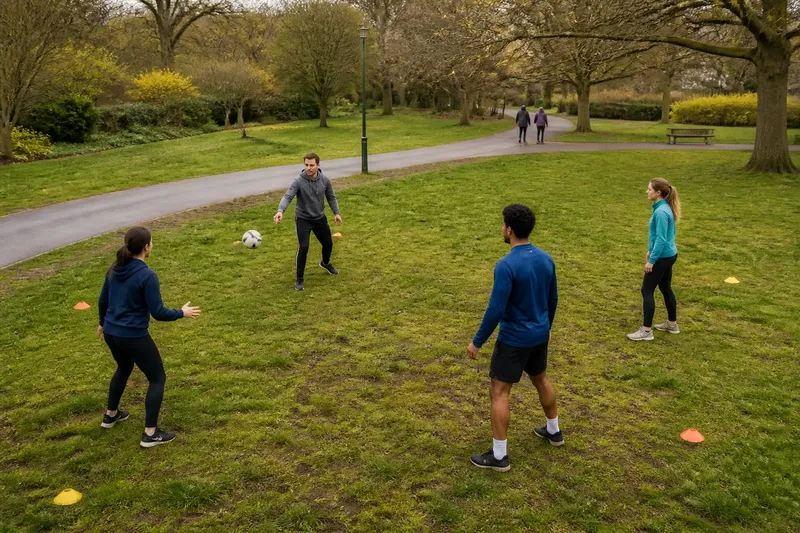
Cones work on grass, firm earth and many paved spaces, provided they stand securely and remain visible. Their main advantage is flexibility: you can widen a goal, shorten a sideline or shift an end boundary without redrawing anything. That makes them useful for a mixed-age group, a warm-up that becomes a game, or a patch of open ground whose usable shape is not a neat rectangle.
Cones are also clear markers for a boundary that is meant to be approximate rather than continuous. Place them at corners and along longer edges so players can infer the line between them. If the gaps are too large, however, players may disagree about whether a ball passed inside or outside the area. Add markers where the line changes direction or where the boundary is difficult to judge.
Choose cones with a colour that contrasts with the ground and the surroundings. A bright marker can disappear among leaves, equipment or other colourful objects, so check the view from the far side of the playing area before the game starts. Low-profile cones can be easier to step over than taller markers, while taller ones may be easier to spot; pick the shape that suits the activity and the space.
Cones can still become trip hazards if players move quickly through them or if they are placed in a running route. Keep markers outside the active path where possible, and make the boundary clear enough that players do not need to crowd around a cone to interpret it. If a marker is knocked over, pause and replace it rather than letting the edge drift unnoticed.
Match the marker to the surface and the sightline
Hard ground often favours chalk for a boundary that needs to be followed continuously. Grass and uneven open ground usually favour cones, because a drawn line may be difficult to apply or see. Neither material fixes a poor sightline: a line hidden by a rise, a crowd or parked equipment remains hard to judge, and cones blocked from view do not help.
Walk around the intended area before setting it out. Look from the positions where players will approach, defend and make calls, not only from the centre. If a boundary is visible from one end but obscured from another, shift the area, increase the contrast or place extra markers at the awkward section.
Think about what counts as “out” before choosing the layout. A game that relies on precise edge calls benefits from a clear continuous boundary where practical; a loose practice game may work with cones at the corners and a shared understanding of the space between them. The marker should match the level of precision the group actually needs.
Choose by situation rather than habit
- For a pavement game with a clear, fixed rectangle: use suitable chalk if marking is allowed and visible on the surface. It provides a continuous edge without leaving cones in the playing route.
- For a grass game on an irregular patch: use cones at the corners and at bends in the boundary. Their positions can describe a workable area without relying on a line that the ground may not show clearly.
- For a game with changing numbers or teams: start with cones. You can move the ends as the group changes, keeping the space proportionate without drawing fresh lines.
- For a shared court or playground: prefer movable markers if permanent or chalk markings could be confused with another activity. Keep the casual game’s edges distinct from existing lines and leave access routes clear.
- For an area with poor contrast: try a visible cone colour or a contrasting chalk shade, depending on the surface. Check from several sides, because the best-looking marker from the set-up point may disappear from a player’s view.
Say a group arrives at a paved park court for a casual passing game, but another group is waiting to use the space afterwards. They could mark only the needed edges with permitted chalk, then choose cones instead if the court markings make those lines confusing; the expected result is a boundary players can identify without mistaking it for the court’s permanent layout.
How should you decide between chalk and cones?
Which is better for grass?
Cones are usually the more practical choice on grass because they can mark corners and turns without depending on a visible drawn line. Check that the markers stand out against the ground and do not sit directly in a busy running lane.
Which is easier to move during a game?
Cones are easier to reposition when the playing area changes, since you can move individual markers. Chalk is better suited to a boundary that will stay put for the session.
Can chalk and cones be used together?
Yes, if the combination makes the boundary easier to read rather than adding clutter. For instance, a visible chalk edge can define a straight side while cones mark corners or a change in direction.
How can players tell where a cone boundary runs?
Set cones along the edge, not just at distant corners, where a gap could cause confusion. Add a marker at each bend and agree that the boundary runs between the cones before play begins.
Set a boundary that stays clear through the session
Before play, point out the edges and settle any rule that depends on them, such as whether a ball touching a line counts as in or out. Then step back and check whether the markers are visible from the far side. A quick shared explanation prevents players from inventing different boundaries once the game gets moving.
Keep the layout simple. Mark the edges that affect play, leave entrances and paths unobstructed, and avoid placing extra cones where they can be mistaken for goals or targets. If the game changes, adjust the area deliberately and tell everyone which boundary has moved.
For a casual game, chalk lines or cones should make the space easier to use, not demand attention for their own sake. Choose chalk for a visible, stable line on an appropriate hard surface; choose cones when the ground, shape or group calls for movement. The best marker is the one that lets players spend less time disputing the edge and more time playing.