Plan a Late-Autumn Park Match Around the Daylight
Plan a late-autumn park match with a clear meeting point, a daylight-led finish and flexible play so everyone knows when and where to turn up.
What time should you arrange a late-autumn park match when daylight can fade before everyone expects? Set the finish by the light, not by a fixed match length, and give the group one precise meeting point and a clear plan for late arrivals. A simple arrangement makes an informal game easier to join and easier to stop.
How do you choose a safe finish time for a late-autumn park match?
Start with the time sunset is expected locally, then plan to finish while players can still see the playing area and find their way back to the park entrance. Sunset is a useful reference, not a signal to keep playing until the last light disappears: trees, buildings and overcast skies can make a familiar patch feel dim sooner.
Pick a finish time that leaves room to collect coats and equipment, gather the group and walk out together if needed. If the park has paths without lighting, or the playing area sits behind trees, build in more daylight rather than relying on phone screens to spot obstacles.
Check the local forecast and sunset information on the day, and send any adjustment to the group promptly. If conditions make it hard to see the ball, other players or the route off the field, call the game there.
What should the invitation say about the meeting point?
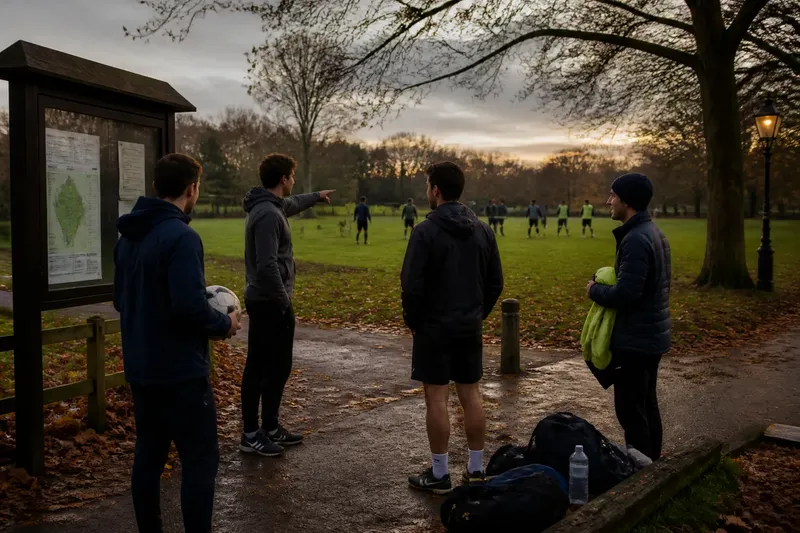
Name a landmark people can identify from a public path, such as the main gate, a particular park noticeboard or the path junction beside the pavilion. “Meet at the far end” is open to interpretation, especially for someone who has not visited before.
Include the park name, the landmark and a simple fallback for anyone who arrives after play starts. For example, say that late arrivals should message the group and wait at the main gate rather than searching the field as visibility drops. Share a map pin if useful, but keep the written description too: a pin may lead to the wrong entrance.
Agree who will check messages and make sure that person knows the expected finish. For a casual group, this can be whoever sends the invitation; the important thing is that latecomers have one reliable contact.
How long should an informal match last?
Give the gathering a window rather than promising a full-length match. You might invite people for a short game between an agreed start and a daylight-led finish, then let the group decide whether to play another round if time and conditions allow.
This keeps the plan workable when people arrive at different times or the light changes quickly. Avoid making an extra round sound expected. Someone who needs to leave early should be able to join for part of the game without disrupting the arrangement.
Say you invite a few friends to meet by the park noticeboard after work. Two people arrive late, so the group starts with a short, low-pressure round; when the light begins to fade, everyone finishes, collects their things and walks out together. The useful part is the agreed endpoint, not how much playing time the group manages.
What should the group agree before play begins?
Keep the opening conversation brief and settle the practical details before anyone heads to the playing area. Confirm:
- Finish signal: Who will call time, and what will prompt the stop?
- Late arrivals: Where should someone wait, and whom should they contact?
- Early departure: Can a player leave without needing to find the group again?
- Equipment: Who is bringing the ball, and who will take it home?
- Exit plan: Which path or entrance will the group use when play ends?
Keep the rules light enough to explain in a sentence or two. A casual match is easier to manage when no one has to pause repeatedly to ask who is in charge of the clock or where the group is going next.
What if players arrive at different times or the light changes?
Use a format that can pause cleanly. A small-sided game, rotating teams or a simple passing activity lets new arrivals join without a long restart, while anyone leaving can do so without changing the whole plan.
Decide in advance that the finish time will not move later just because someone was delayed. If the sky darkens early, shorten the game and use the agreed message channel to tell anyone still on the way that play has ended. A clear update is kinder than leaving a latecomer to search the park.
When the group splits between the field and the entrance, make sure everyone knows where to reunite. Do not assume that a player who leaves early will automatically find the others in a dim park.
What practical details make a cold-weather meeting easier?
Tell people to arrive dressed for standing around as well as moving. A warm outer layer that can be taken off during play, plus a dry layer for the journey home, is often more useful than relying on a long warm-up to keep everyone comfortable.
Ask players to bring water and to keep bags and spare clothing together at a place that does not obstruct paths. If the group uses a phone for the meeting plan, consider carrying a small torch for the walk back, but do not use a torch as a reason to extend play after visibility has become poor.
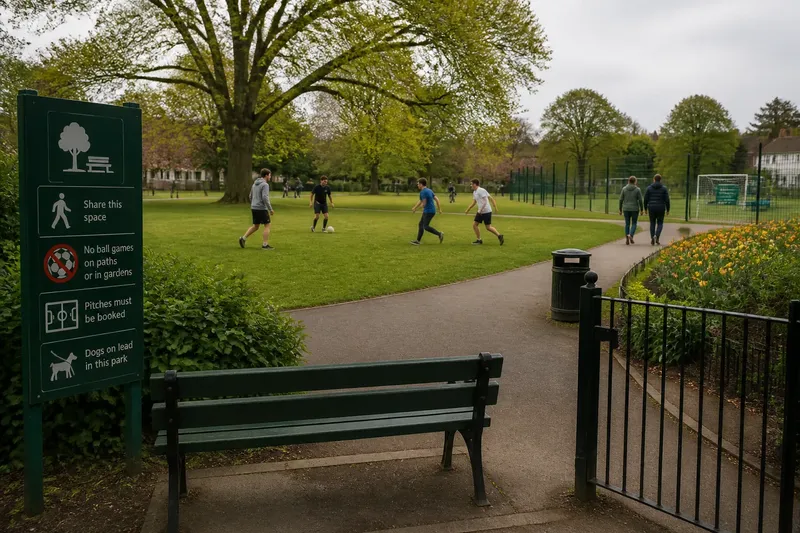
For park access, lighting, permitted hours and any local restrictions, check the relevant park notice or council information. Follow any posted instructions and adapt the meeting point or timing if access arrangements require it.
How can you keep the match welcoming for first-time players?
Make the invitation specific about the activity and the level of commitment: say whether people can drop in, whether equipment is available to share and whether the game will stop at a set time. A new player is more likely to arrive confidently if they know what to expect and who to look for.
Greet newcomers at the agreed landmark before the group moves away from it. Give them the short version of the rules and explain the finish plan; there is no need to make them learn every detail before joining a simple game.
When should you cancel rather than shorten the game?
Cancel if poor visibility, unsafe access, severe weather or a park closure makes the meeting unsuitable. A shorter match is a sensible adjustment only while players can still take part and leave comfortably.
Send the cancellation through the same channel as the original invitation, state plainly that the game is off and avoid leaving the decision to people who are already travelling. If conditions are uncertain, give the group a decision time and name the person who will send the update.
A late-autumn park match works best when the invitation makes its boundaries clear: where to meet, when play will stop and how the group will handle changes. Keep those details in the message, and the late-autumn park match can stay relaxed without asking anyone to guess what happens as daylight fades.